“Since movies were invented, we have lived three times as long.”
This line, spoken by little Yang-Yang near the end of Edward Yang’s Yi Yi, contains the entire philosophy of cinema in a single sentence. Movies allow us to see what we cannot see, to experience what we have not experienced, to live beyond the boundaries of our single life. Yi Yi is a family epic that has existed in this world longer than I have, yet its power continues to ripple through generation after generation.
What is it that humans can never see? When this riddle is posed early in the film, the answer hangs suspended in the air. It isn’t until the end that little Yang-Yang gives us the answer: we cannot see our own backs, we cannot see ourselves from the outside, we cannot fully know who we are. It is direct and simple, yet his innocence foreshadows a cruel truth: growing up is a process of constant loss. The more we strain to see what is hidden, the more it eludes us.
I first watched Yi Yi when I was twenty-two, and I thought I understood it. I saw it as a film about family, about the passage of time, about the small moments that comprise a life. But watching it again at twenty-eight, I realized how much I had missed. The film is not just about what we can see but about what we choose not to see, about the way we avert our eyes from uncomfortable truths, about the way we construct narratives to make sense of the chaos of existence.
Each member of the family is struggling with their own crisis of meaning. NJ, the father, encounters his first love and is forced to confront the path not taken, the life he might have lived. His wife has a spiritual crisis and retreats to a monastery, searching for answers that may not exist. Their daughter falls in love with a boy who may be using her. Their son takes photographs of the backs of people’s heads, trying to show them what they cannot see. And the grandmother lies in a coma, hovering between life and death, while the family members take turns speaking to her, confessing their fears and disappointments.
We have yet to fathom the thesis of life, but the world has already watched us grow old. This is the tragedy that Yi Yi captures so perfectly. We spend our lives searching for meaning, for understanding, for some kind of answer to the question of existence. But by the time we begin to glimpse the truth, it is already too late. Time has passed. Opportunities have been lost. The people we love have died or drifted away.
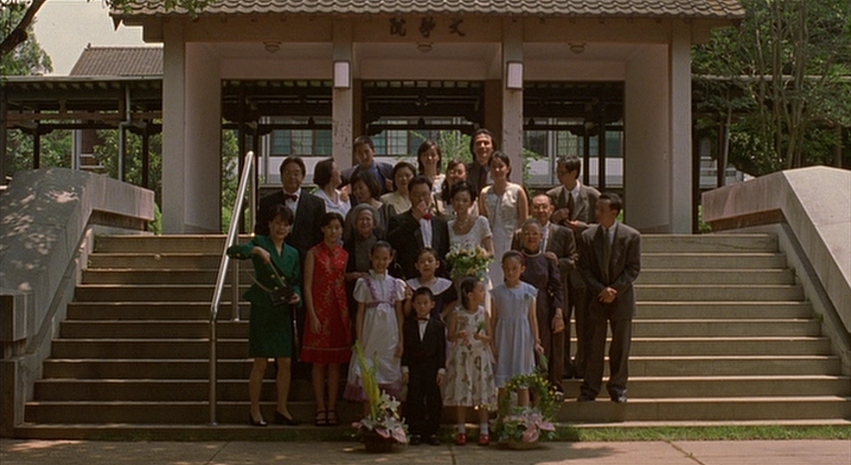
Bookended by a wedding and a funeral, life feels so fleeting, yet the days feel so long. This paradox is at the heart of Yi Yi. The film is three hours long, yet it feels like a lifetime. Edward Yang uses long, static shots to capture the rhythms of daily life: meals eaten in silence, conversations that go nowhere, moments of connection that are fleeting and fragile. He understands that life is not made up of dramatic events but of these small, ordinary moments that accumulate over time.
What moves me most about Yi Yi is its profound empathy for every character. There are no villains here, no moral judgments, no easy answers. Each person is doing their best to navigate the complexity of existence, to find meaning in a world that often seems meaningless. The film suggests that this struggle is universal, that we are all searching for the same things: love, connection, understanding, purpose.
From now on, I, too, want to tell people what they don’t know, and show them what they cannot see. Just like Edward Yang. He used three hours to show us “half” of a life. And the other half? We just have to keep living. Perhaps, slowly, we will understand. Or perhaps we never will. But the search itself, the attempt to see what cannot be seen, is what makes us human.