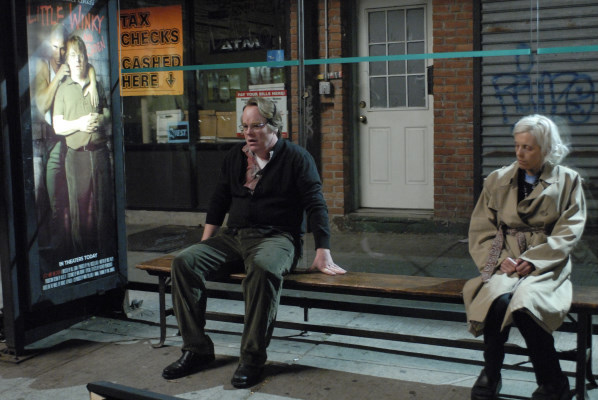
I’ve watched Synecdoche, New York three times, and I still don’t fully understand it. But I feel it. In my bones. In the pit of my stomach. In the creeping dread that I’m wasting my life.
Charlie Kaufman’s directorial debut is about Caden Cotard, a theater director who receives a grant to create his masterwork. He decides to create a massive, life-sized replica of New York inside a warehouse, populated by actors playing real people, including himself. And then he creates a replica of the replica. And it spirals from there, layers upon layers, until you can’t tell what’s real and what’s performance.
The film is also about Caden’s life falling apart. His wife leaves him. His daughter grows up hating him. He gets sick—mysteriously, progressively, in ways that don’t quite make medical sense. Time moves strangely. Years pass in what feels like days. People age, die, are replaced. And Caden keeps building his play, trying to capture the truth of existence, trying to create something meaningful before he dies.
It’s a film about the impossibility of art, the futility of trying to capture life, and the way that obsession destroys the very things it’s trying to preserve.
I first watched it when I was twenty-two and thought I was going to be a writer. I was working on this novel that I was convinced would be important, would mean something, would justify my existence. And watching Caden pour his life into his play—neglecting his relationships, his health, his actual life in pursuit of art—I saw myself. And it terrified me.
There’s a scene where Caden is talking to an actress who’s playing his wife in the play, and he can’t remember if he’s talking to the actress or the real person. The boundaries have dissolved. He’s so deep in his own creation that he’s lost touch with reality. And I thought: this is what happens when you live in your head. When you spend so much time trying to capture life that you forget to live it.
The film is also deeply, crushingly sad. Everyone Caden loves leaves him or dies. His daughter grows up in Germany, becomes a tattooed artist, and dies young. His wife becomes famous without him. The women he loves drift away. And he keeps working on his play, which never opens, which just keeps expanding, consuming more and more of his life.
By the end, Caden is old, sick, playing a minor role in his own play, taking direction from someone else. He’s no longer the creator. He’s just another actor, following instructions, waiting for the end. And the film ends with a voice in his ear, telling him what to do, and then silence.
I finished the film feeling hollowed out. Because it asks the question I’m most afraid of: what if the thing you’re devoting your life to is pointless? What if your art doesn’t matter? What if you’re so busy trying to create meaning that you miss the actual meaning, which is just… living? Being present? Loving people?
I haven’t written much since I watched Synecdoche, New York the third time. Not because the film discouraged me, but because it forced me to ask: why am I doing this? Is it because I have something to say? Or is it because I’m afraid of being forgotten? Am I creating, or am I just building my own warehouse full of replicas?
I don’t have answers. But the film stays with me, like a splinter I can’t remove. It’s uncomfortable and confusing and probably too ambitious for its own good. But it’s also one of the most honest films about the creative process I’ve ever seen. It doesn’t romanticize art. It shows you the cost. The loneliness. The obsession. The way it can consume you until there’s nothing left.
Would I recommend it? I honestly don’t know. It’s a hard watch. It’s depressing. It’s confusing. But if you’re an artist, if you’ve ever felt like you’re wasting your life chasing something you can’t define, it will destroy you in the best and worst way.