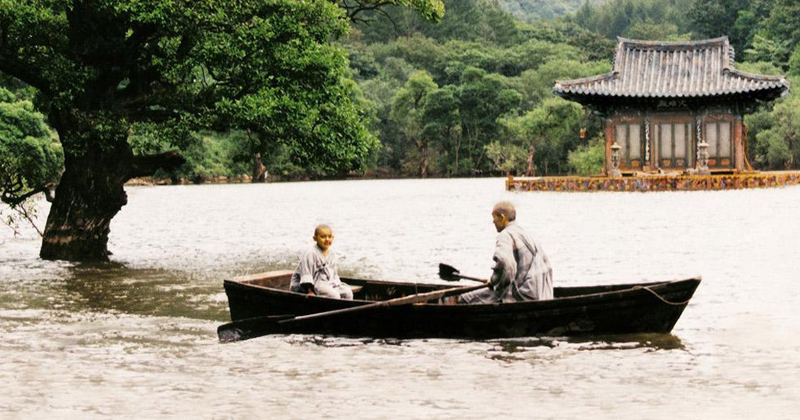
I watched Spring Summer Fall Winter and Spring on a retreat, alone in a cabin by a lake. It felt like the only appropriate setting for this film—isolated, quiet, surrounded by nature.
Kim Ki-duk’s film takes place entirely on a floating temple in the middle of a lake. An old monk and a young boy live there, following the rhythms of the seasons. And the film is structured around those seasons: Spring (childhood), Summer (adolescence), Fall (adulthood), Winter (old age), and Spring again (rebirth).
It’s a simple structure, almost fable-like. But within that simplicity, Kim explores profound questions about karma, violence, desire, and redemption.
In Spring, the boy ties stones to a fish, a frog, and a snake, watching them struggle. The old monk sees this and, while the boy sleeps, ties a stone to his back. When the boy wakes, he’s forced to carry the weight, to feel what he inflicted on the animals. And the monk tells him: if any of those creatures died, he’ll carry that weight in his heart for the rest of his life.
I thought about the casual cruelties I’ve committed. The small violences. The times I’ve hurt people without thinking. And I wondered: what stones am I carrying? What weights have I forgotten?
In Summer, a sick girl comes to the temple to heal. The boy, now a teenager, falls in love with her. They have sex. She leaves. He follows her, consumed by desire, abandoning the temple and his training. The old monk lets him go. Because some lessons can only be learned through suffering.
In Fall, the boy returns as a man. He’s killed someone in a jealous rage. He’s being pursued by police. The old monk takes him in, forces him to carve the Heart Sutra into the wooden floor of the temple as a form of meditation and penance. The man carves, weeps, purges his guilt. And when he’s done, the old monk commits suicide, taking on the man’s karma, freeing him to start again.
I cried during this section. Because the old monk’s sacrifice is an act of pure compassion. He sees the man’s suffering and chooses to absorb it, to carry it, to transform it. It’s the most profound act of love I’ve seen in cinema.
In Winter, the man is now old, living alone in the temple. A woman comes, abandons her baby, and drowns herself in the lake. The old man rescues the baby and begins raising him, just as he was raised. The cycle continues.
And then Spring returns. The boy is young again (or is it a different boy? The film doesn’t say). And the old man carves the Heart Sutra into his own body, climbs the mountain, and sits in meditation, transforming himself into a living statue.
The film ends with the boy tying stones to a fish. The cycle begins again.
Spring Summer Fall Winter and Spring is a film about the cyclical nature of existence. We make mistakes. We suffer. We learn. We pass on what we’ve learned. And the cycle continues. There’s no final resolution, no ultimate enlightenment. Just the endless turning of the seasons, the endless repetition of birth, growth, decay, and rebirth.
After I finished watching, I sat by the lake for a long time, watching the water, thinking about cycles. My own patterns. The mistakes I keep making. The lessons I keep forgetting. The ways I hurt people, get hurt, try to heal, try again.
The film doesn’t offer easy answers or quick fixes. It just shows you the process. The long, slow work of transformation. The way that suffering can be transmuted into wisdom, but only through discipline, through practice, through the willingness to sit with your pain and carve it into something beautiful.
I left the cabin feeling lighter. Not because the film solved anything, but because it reminded me: this is the work. This is the practice. This is what it means to be human—to carry your stones, to carve your sutras, to pass on what you’ve learned, and to trust that the cycle continues.