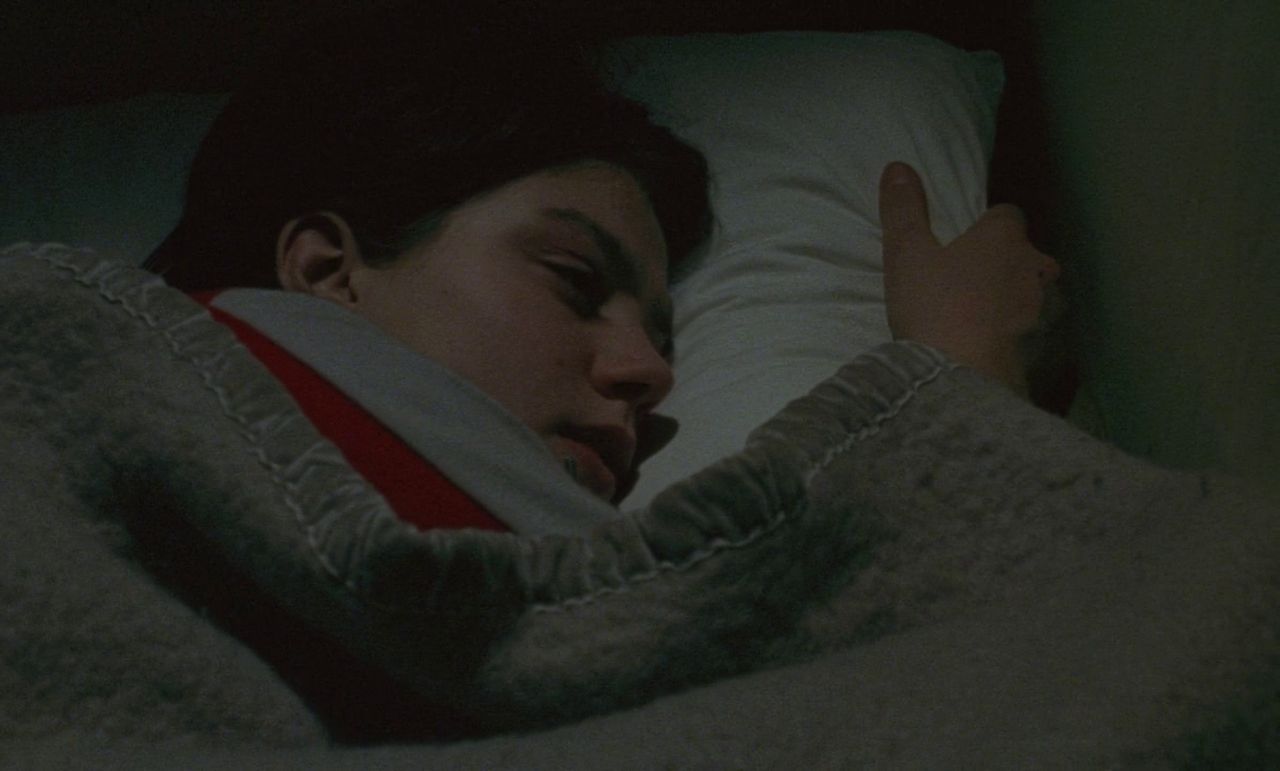
Fish hooks set on glass jars. A river thick with mud. The meager warmth of a hairdryer. A girl’s stubborn back. A gas canister that refused to light. These are the images that stay with me from the Dardenne brothers’ Rosetta, a film so physically immediate, so viscerally real, that I felt bruised after watching it.
Rosetta only allows herself the reward of a “good night” when she has secured a job—because only in that moment does the future feel like something other than a stagnant loop. That slight flush on her cheeks offers the only splash of color in a life otherwise painted in humiliation and cruelty. I understand this logic completely. When you are trapped in poverty, when every day is a struggle for basic survival, the smallest victory becomes monumental. A job is not just employment; it is dignity, it is purpose, it is proof that you exist in the world as something more than a burden.
The handheld, documentary-style camerawork is another masterclass in the Dardenne brothers’ ethos: show, don’t explain. The camera follows Rosetta relentlessly, staying close to her body, tracking her movements with an almost obsessive intensity. We feel every step she takes, every breath she struggles to catch. I vividly recall the scene where she struggles with menstrual cramps; watching her, I felt a phantom ache in my own body. It was the growing pain of girlhood—poignant, beautiful, and utterly desperate.
What devastates me most about Rosetta is the way it captures the loneliness of survival. Rosetta is offered friendship, offered kindness, offered a way out of her isolation. But she cannot accept it. She has been so thoroughly brutalized by her circumstances that she can only see other people as threats or competitors. When Riquet offers her genuine connection, she betrays him without hesitation, because in her world, there is only room for one person to survive. The film does not judge her for this. Instead, it asks us to understand the logic of desperation, the way that poverty distorts human relationships and makes genuine connection nearly impossible.
The way she flees in panic when she gains a friend, and the way she dodges and digs her heels in when she loses one—it all culminates in that final, collapsing wail on the ground. It is an ending so steeped in black humor, yet it lays bare the sheer bitterness of survival. When Riquet returns to help her, when he lifts her up despite everything she has done to him, I wept. Not because it is a happy ending—it is not—but because it suggests that human kindness can persist even in the face of betrayal, that we are capable of grace even when we have every reason to turn away.
I think about Rosetta often. I think about her stubborn determination, her refusal to give up even when every force in the world is pushing her down. I think about the way she runs—always running, as if she can outpace her circumstances, as if forward motion alone can save her. The film understands that poverty is not a static condition but a constant struggle, a daily battle that exhausts the body and the spirit.
The Dardenne brothers refuse to romanticize poverty or turn Rosetta into a noble victim. She is flawed, she is cruel, she makes terrible choices. But the film asks us to see these flaws not as moral failings but as the inevitable result of a system that offers no support, no safety net, no path forward. Rosetta is fighting for her life in the most literal sense, and in that fight, she has been forced to abandon the luxury of morality.
Rosetta, life isn’t static. Hope lands, and hope falls through. Rosetta, the pain in your belly will linger, but one day it will fade. Rosetta, you are the toughest girl I know, and the one who breaks my heart the most. I want to reach through the screen and tell you that you deserve more than this, that your life should be about more than just survival. But I know you cannot hear me. You are too busy running, too busy fighting, too busy trying to make it through one more day.