A runaway bride frozen in time. A horse thrashing in its final death throes. A violinist whose melody is left hanging in the cold air. A truck that bleeds silently into the street. Even the “Hand of God”—that massive stone sculpture rising from the sea—looks broken and weary, a severed limb drifting away into the gray, pointing nowhere.
I have watched Landscape in the Mist three times now, and each time I am left breathless by Angelopoulos’s ability to capture death and celebration in a single, unblinking frame. This is not a film that explains itself to you. It does not hold your hand or offer comfort. Instead, it asks you to sit with its images, to let them seep into your consciousness like fog rolling over a landscape.
The two children at the center of this story are searching for a father who may not exist. They are chasing a myth, a fairy tale, a promise that somewhere beyond the mist there is warmth and belonging. But what they encounter instead is the brutal machinery of the adult world—a world of exploitation, violence, and profound loneliness. When the girl suffers the ultimate violation, the film leaves a stain of humiliation that words cannot reach. The brutality of growing up is a silent, arid thing—a dryness that chokes you. The tears that refuse to fall are the ones that suffocate us the most.
I think about that scene often. The silence of it. The way Angelopoulos refuses to dramatize or sentimentalize the violence. He simply shows us the aftermath: a child’s face, blank and distant, as if a part of her has been permanently severed from the world. It is one of the most devastating moments I have ever witnessed in cinema, precisely because it is so quiet, so understated. The film understands that some traumas are too profound for tears, that sometimes the body simply shuts down, retreats into itself, becomes a shell.
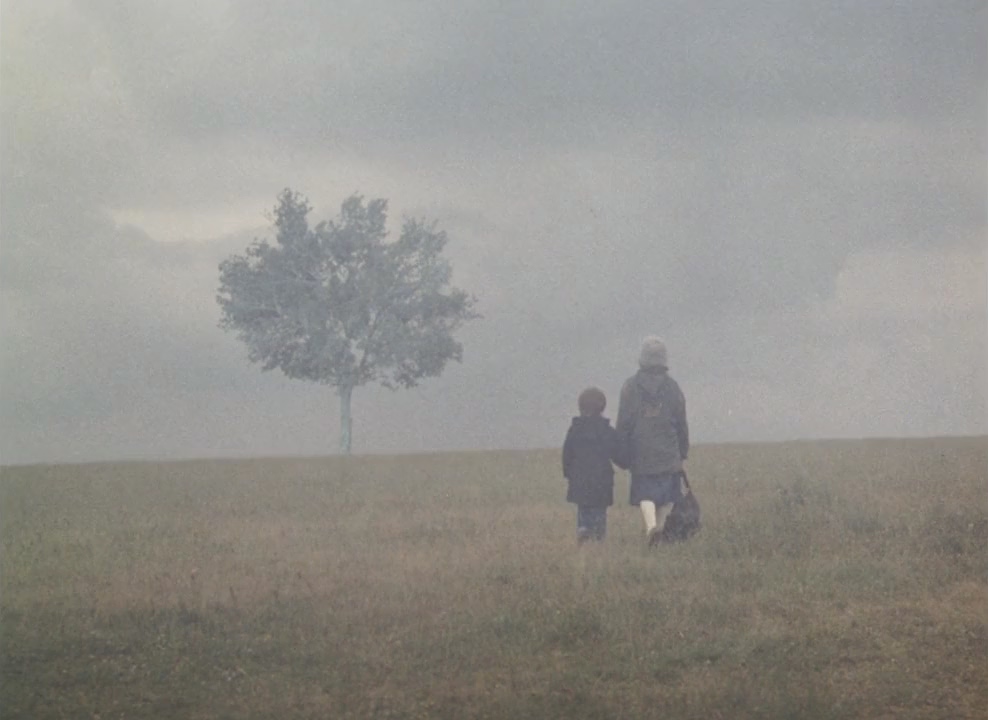
Yet, even in the midst of this darkness, there are moments of startling beauty. The children dancing in the snow. The wedding celebration glimpsed through a window. The tree shrouded in fog that they embrace at the film’s end. These images are not meant to provide resolution or comfort. Instead, they exist in tension with the film’s darkness, suggesting that beauty and cruelty are not opposites but rather two sides of the same coin. Life contains both, often in the same moment, and we must learn to hold both truths simultaneously.
Angelopoulos uses his signature, hypnotic long takes to compose a ritual of cruel maturation. Each shot is held for what feels like an eternity, forcing us to inhabit the time and space of the children’s journey. We cannot look away. We cannot fast-forward. We must sit with them in their waiting, their walking, their searching. This is cinema as endurance, as meditation, as prayer.
What strikes me most about Landscape in the Mist is its refusal to offer easy answers or false hope. The children do find their tree in the fog, but what does it mean? Is it a symbol of hope, or simply another illusion, another myth to sustain them through the harshness of existence? Angelopoulos does not tell us. He leaves us suspended in that fog, uncertain, searching, just like the children themselves.
I have never seen a fairytale so profoundly sad. Precisely because the pure beauty in this world is so fragile, the collapse of faith feels all the more shattering. The film understands that childhood is not a protected space but rather a battlefield, a place where innocence is systematically destroyed by the indifference and cruelty of the adult world. Yet, even as it documents this destruction, it also suggests that there is something indestructible in the human spirit, something that continues to search for meaning and beauty even in the face of overwhelming darkness.
This is more than a movie. It is a film that permanently alters the way one perceives cinema. It is a poem to be revisited, again and again, throughout the long, misty journey of life. Each time I return to it, I find new layers of meaning, new images that haunt me, new questions that refuse to be answered. It is a film that grows with you, that changes as you change, that remains forever elusive and forever profound.