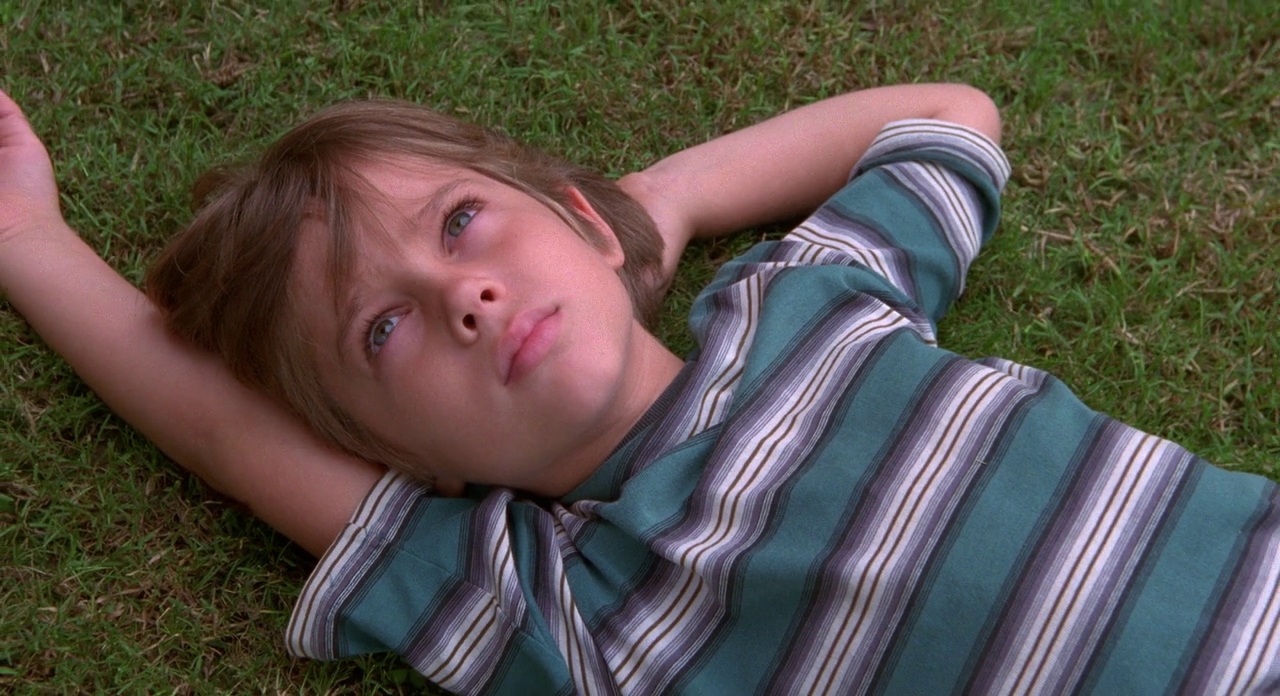
I watched Boyhood when I was twenty-four, and I cried because I recognized my own life in Mason’s.
Linklater filmed this over twelve years, using the same actors, watching them age in real time. Mason goes from six to eighteen, and we watch every awkward phase, every haircut, every small moment of growth. It’s not a plot-driven film. It’s just… life. Unfolding. Accumulating. Passing.
What struck me most is how the big moments aren’t the ones that matter. Mason’s parents divorce, but we don’t see the dramatic fight. His mom remarries an abusive alcoholic, but we don’t see the worst of it. His sister goes to college, his dad gets remarried, life keeps moving. And the film doesn’t linger on any of it. Because that’s not how life works. The big moments happen, and then you keep going.
What the film does linger on are the small moments. Mason and his dad lying on the grass, looking at clouds. Mason’s first girlfriend. The awkward conversation about sex. The photography class. The moment he realizes his childhood is over and he’s not ready.
There’s a scene near the end where Mason’s mom is helping him pack for college, and she has a breakdown. She says something like, “I thought there would be more.” She’s realizing that her life has been a series of milestones—marriage, kids, divorce, remarriage, kids leaving—and now what? What’s next? What was it all for?
I had to pause the film. Because my own mom said something similar to me when I left for college. And I didn’t know how to respond then, and I still don’t know now.
Boyhood captures something I’ve never seen in another film: the texture of time passing. Not time as a plot device, but time as experience. The way you don’t notice yourself changing until you look back and realize you’re a completely different person. The way childhood doesn’t end dramatically—it just fades, gradually, until one day you realize it’s gone.
Mason is not a particularly remarkable kid. He’s not a genius or a rebel or a hero. He’s just… a kid. He makes mistakes, he’s sometimes selfish, he’s figuring things out. And that’s what makes the film so powerful. Because most of us aren’t remarkable. Most of us are just trying to figure it out, one day at a time.
The film ends with Mason at college, sitting on a rock with a girl he just met, watching the sunset. And she says something about how we’re always trying to seize the moment, but really, the moment seizes us. And Mason smiles. And the film ends.
And I sat there, twenty-four years old, realizing that my own boyhood was over. That I was in the middle of my own life, and I hadn’t noticed when it started. That time was passing, right now, in this moment, and I couldn’t hold onto it.
I called my dad after I watched it. I don’t remember what we talked about. Probably nothing important. But I wanted to hear his voice. I wanted to mark the moment, even though I knew I couldn’t keep it.
Boyhood is a film about the impossibility of preserving time, and the beauty of trying anyway. It’s a film that makes you want to pay attention, to notice the small things, to be present. Because this is it. This is your life. It’s happening right now. And you can’t seize it, but you can witness it.
And maybe that’s enough.