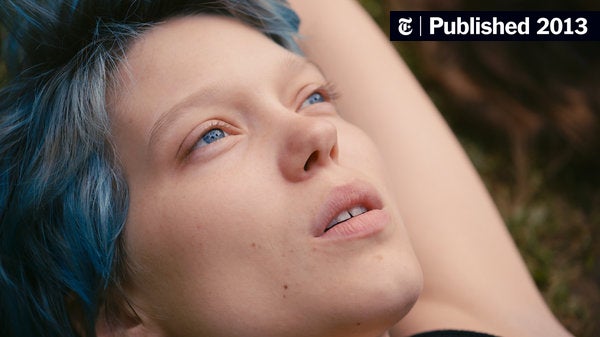
Even after all these years, I still remember that touch of blue fading away at the street corner. This film is so intensely personal to me that I find it impossible to analyze through a critical lens. It is not a film I watch; it is a film I live through, again and again, each viewing revealing a different layer of my own experience.
I first watched Blue Is the Warmest Color when I was sixteen, as raw and bewildered as Adèle herself. Life was driven mostly by instinct—eating when hungry, sleeping with lips slightly parted, the clumsy attempt to hide naivety in a bar, the uncontrollable smile when looking at a lover, and the involuntary trembling during a fight. I saw myself completely in Adèle’s fumbling attempts to understand her own desire, her confusion about who she was supposed to be versus who she actually was. The film captured something I had never seen represented before: the messy, physical reality of first love, the way it consumes you completely, the way it makes you feel both more alive and more vulnerable than you have ever been.
Watching it again at twenty, the foreshadowing of separation cast a gray shadow over those heart-fluttering moments. I could see the cracks forming even in the happiest scenes. I could see the ways that Adèle and Emma were fundamentally incompatible, the ways that their different backgrounds and aspirations would eventually pull them apart. Yet, I also understood something I had missed the first time: blue is the warmest color. When you fall in love, a part of that person stays with you forever. You carry it with you as you keep walking forward. The love does not disappear when the relationship ends; it transforms, becomes a part of who you are, shapes the way you see the world.
Watching it for the third time at twenty-five, my favorite scene is Adèle’s eighteenth birthday. She dances alone in the crowd, her body moving with abandon, her face flushed with joy and alcohol and the overwhelming feeling of being young and in love. In that moment, her heart is full of her lover. In that moment, she is still so young. In that moment, her favorite dish is pasta with red sauce. In that moment, the messy, humiliating end has not yet arrived. I watch this scene and I want to reach through the screen and tell her to hold onto this feeling, to remember it, because it will not last. But I also know that the impermanence is what makes it beautiful. If it lasted forever, it would not mean as much.
What Abdellatif Kechiche understands, what makes this film so devastating and so true, is that love is not about grand gestures or perfect moments. It is about the mundane, the ordinary, the daily rituals that bind two people together. Adèle eats ordinary food, works an ordinary job, lives an ordinary life. Yet, Kechiche uses such an intimate, microscopic gaze to show us the bedrock of love—how infinite beauty can be born from loneliness and loss. He films Adèle eating with the same intensity that other directors reserve for sex scenes. He understands that the way someone eats, the way they sleep, the way they move through space—these are the things that make us fall in love, not the idealized versions of ourselves we present to the world.
The sex scenes in this film have been controversial, and I understand why. They are explicit, they are long, they are unflinching. But to me, they are also deeply honest. They capture the way that sex, especially first sex, is both beautiful and awkward, both transcendent and embarrassingly physical. They show us bodies as they actually are, not as they are presented in most films. And they show us the way that physical intimacy can be a form of communication, a way of saying things that cannot be said with words.
Blue love is dazzling. But love always lingers long after the passion fades. The film’s final act, which follows Adèle and Emma’s breakup and their eventual reunion in a café, is almost unbearably painful to watch. They sit across from each other, tears streaming down their faces, and Emma says, “I have infinite tenderness for you. Always. My whole life.” And I believe her. The love has not disappeared; it has simply changed form. They cannot be together, but they also cannot fully let go of each other. They are bound by their shared history, by the person they became when they were together.
Love is cruel. But I’d like to believe that in the many ordinary years to come, blue—that warmest of colors—has taught Adèle how to love herself. The film ends with Adèle walking away from Emma’s art opening, alone but not defeated. She is wearing a yellow dress, not blue. She is moving forward, carrying the love with her but no longer defined by it. This is what growth looks like. This is what survival looks like. And it is both heartbreaking and hopeful in equal measure.