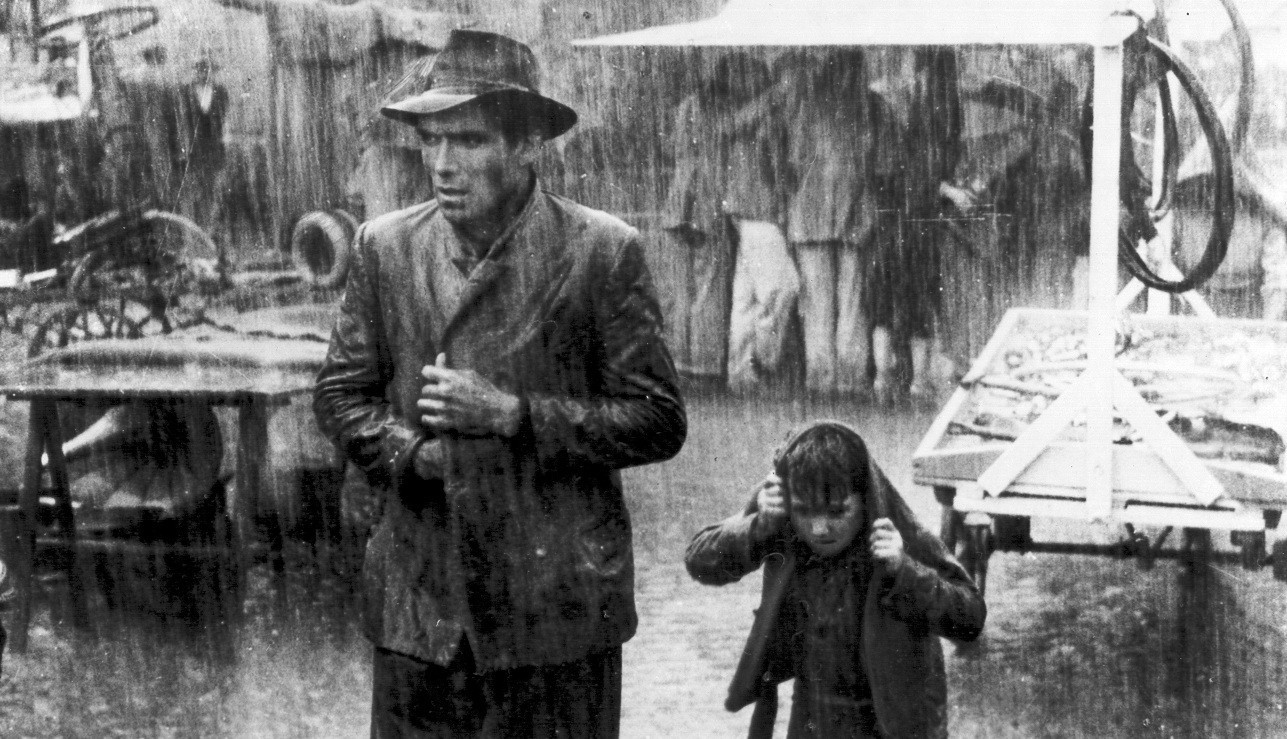
I watched Bicycle Thieves in a film class in college, and I remember thinking it was “important” but not particularly moving. It was black and white, it was old, it was Italian neorealism—all the things you’re supposed to respect but not necessarily feel.
Then I watched it again last year, after I’d been laid off from my job. And I sobbed through the entire second half.
The plot is devastatingly simple: Antonio finally gets a job putting up posters around Rome. But he needs a bicycle for the job. He pawns his family’s sheets to get his bicycle out of hock. And on his first day of work, the bicycle is stolen. Without it, he can’t work. Without work, his family will starve. So he and his young son, Bruno, spend the entire film searching Rome for the bicycle.
That’s it. That’s the whole movie. A man looking for his stolen bicycle.
But De Sica turns this simple story into a profound meditation on poverty, dignity, and the way that economic desperation erodes our humanity. Antonio is not a bad person. He’s a good father, a loving husband, a hard worker. But the system has failed him so completely that he’s pushed to the edge of desperation.
There’s a scene in a restaurant that gutted me. Antonio and Bruno are searching, exhausted and hungry. They pass by a restaurant where a wealthy family is eating. The contrast is stark—the rich family barely notices their abundance, while Antonio and Bruno are starving. Antonio makes a decision: he’ll spend money they don’t have to buy Bruno a meal. Just this once, they’ll eat like the rich people.
They sit down. They order. And for a few minutes, they pretend they’re not poor. Bruno’s face lights up. He’s so happy. And Antonio watches him, knowing this moment of normalcy is temporary, knowing they’ll go back to desperation as soon as the meal is over.
I had to pause the film there. Because I remembered what it felt like to be broke, to count every penny, to occasionally splurge on something small just to feel human again. That scene captured something I’d never seen in a film before—the specific shame and defiance of poverty.
The ending is famous, and I won’t spoil it. But I will say that it shows how poverty doesn’t just take away your money. It takes away your choices. It takes away your dignity. It forces you to become someone you never thought you’d be.
After Antonio makes his choice, Bruno looks at him differently. The boy has seen his father’s failure, his father’s weakness, his father’s humanity. And Antonio knows it. He’s lost more than just a bicycle. He’s lost his son’s uncomplicated admiration.
But then—and this is what broke me—Bruno reaches up and takes his father’s hand. He doesn’t say anything. He just holds his hand. And they walk away together, into the crowd, two small figures disappearing into the masses of Rome.
That gesture of forgiveness, of solidarity, of love despite everything—that’s what the film is really about. Not the bicycle. The hand-holding.
I closed my laptop and sat there for a long time, thinking about my own father, about the times I’ve seen him struggle, about the grace of being able to forgive the people we love for being human.
Bicycle Thieves is seventy-five years old, but it’s not dated. Poverty hasn’t changed. Desperation hasn’t changed. The choice between dignity and survival hasn’t changed. This film will always be relevant, and that’s the saddest thing about it.