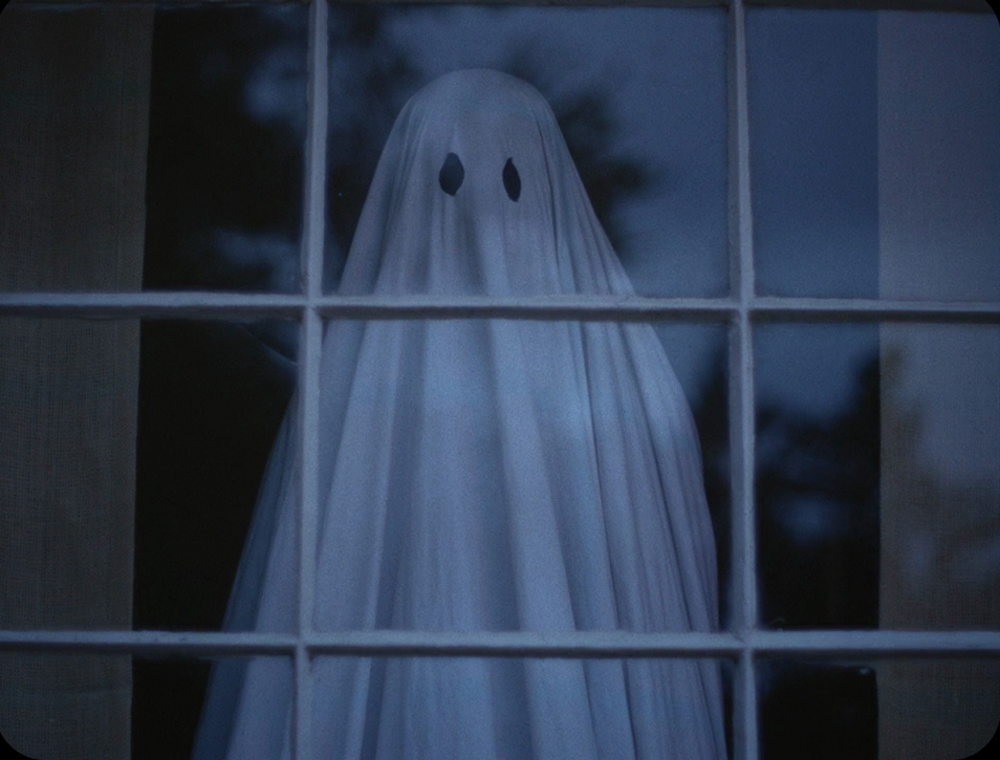
I watched A Ghost Story alone at midnight, and I had an existential crisis.
The premise sounds almost comical: a man dies in a car accident and comes back as a ghost—literally just a dude in a white sheet with eye holes cut out. He haunts his old house, watching his wife grieve, watching her move on, watching time pass.
But this isn’t a horror movie. It’s a meditation on time, loss, and the unbearable weight of existence.
The ghost can’t communicate. He can’t touch anything. He can only watch. And we watch with him. We watch his wife eat an entire pie in one long, unbroken take, grief-eating in the most visceral, uncomfortable way. We watch her pack up and move out. We watch new people move in. We watch the house change, decay, get demolished. We watch centuries pass.
And the ghost is still there. Trapped. Waiting for something he can’t name.
There’s a scene at a party where a drunk guy delivers this long monologue about how nothing matters, how all of human achievement will eventually be dust, how Beethoven’s symphonies will be forgotten, how the universe will end in heat death and none of this will have mattered. And the ghost just stands there, listening, unable to respond.
I had to pause the film. Because that monologue articulated a fear I’ve carried for years: what if nothing I do matters? What if all of this—the work, the relationships, the art, the love—is just temporary? What if we’re all just ghosts, haunting our own lives, waiting for meaning that never comes?
But then the film keeps going. And the ghost keeps waiting. And eventually, he finds what he’s been looking for—a note his wife left in the wall before she moved out. He pulls it out, reads it (we don’t see what it says), and finally, he’s released. He disappears.
And I realized: the content of the note doesn’t matter. What matters is that he waited. That he stayed. That he bore witness to time passing, to life continuing, to the world moving on without him. And in that witnessing, there was meaning. Not grand, cosmic meaning. Just the small, stubborn meaning of staying, of caring, of loving even when love is impossible.
The film is slow. Painfully slow. Long stretches of nothing happening. Just the ghost standing there, the camera holding on him, time passing. And that slowness is the point. Because that’s what grief feels like. That’s what loss feels like. Not dramatic, not cinematic. Just slow. Just waiting. Just enduring.
After the film ended, I sat in the dark for a long time, thinking about the people I’ve lost. Not to death, but to time, to distance, to the inevitable drift of life. And I thought about how we’re all haunting each other, in a way. Carrying ghosts of past selves, past relationships, past versions of the people we love.
A Ghost Story is not for everyone. It’s weird, it’s slow, it’s deeply melancholic. But if you’re in the right mood—if you’re willing to sit with the discomfort, to let the film’s rhythms wash over you—it’s devastating. It’s a film about the impossibility of letting go, and the necessity of trying.
Also, that pie-eating scene is now burned into my brain forever. I can never look at pie the same way.